
Case study: from infiltration between two apartments to the final report
A complete fictional case, explained step by step: two apartments, methods, findings, conclusion, limitations, and recommendations.
This case is entirely fictional. It only shows how to organise a case involving two apartments and several investigation steps.
The scenario: after several periods of rain, marks reappear above the bay window in the living room of apartment 3B. The terrace of apartment 4B is directly above that area.
1. Initial request
Infiltration reported above the living-room bay window during heavy rainfall.
Why this sentence works: it describes the reported problem without announcing its source too early.
2. Apartment 3B — affected location
The report records:
- runoff marks above the frame;
- localised paint damage;
- slightly warped flooring nearby;
- no active water ingress observed during the visit.
The last point matters: no water during the visit does not necessarily contradict an intermittent, rain-related phenomenon.
Key point: the report documents the condition at the time of the visit and distinguishes what was observed from what the occupant reported.
3. Apartment 4B — suspected source
The upper terrace presents several elements to check:
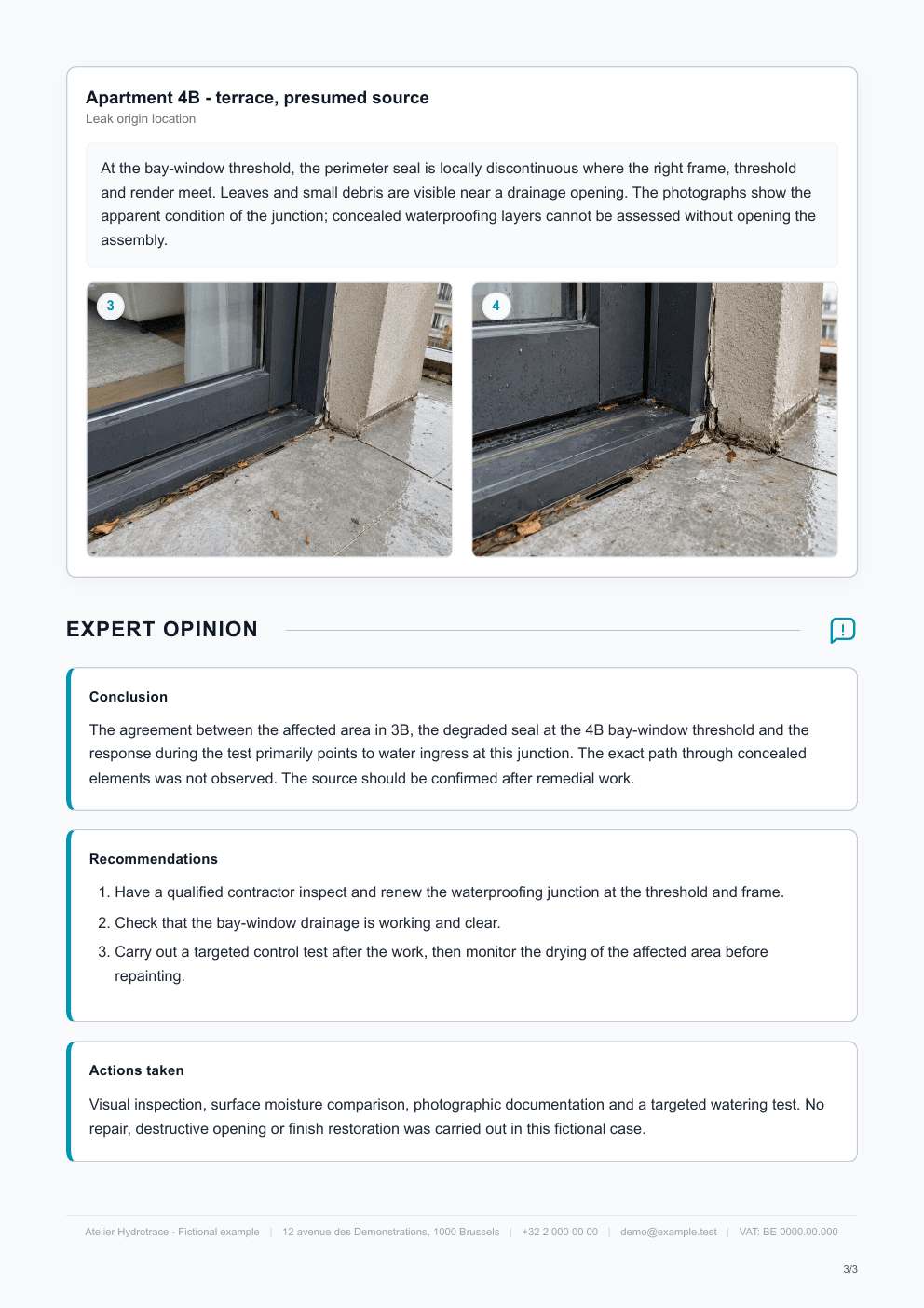
- damaged lower window-frame seal;
- a closure defect;
- partially blocked drains;
- a visible opening at the threshold junction.
None of these defects should be presented on its own as absolute proof of the source.
The report first documents them as findings.
4. Targeted test
Progressive water test on the lower part of the frame and its junction with the threshold. After several minutes, renewed moisture is observed in the previously identified area at the lower level.
This passage is useful because it specifies:
- the tested area;
- the method;
- the result;
- the link with the affected location.
5. Conclusion
The findings recorded in both apartments, combined with the water-test result, mainly point towards a sealing defect at the frame and threshold junction in apartment 4B.
The conclusion contains no new fact. It brings together elements already present in the report.
It also stays proportionate: “mainly point towards” describes a strong body of evidence without claiming that destructive opening proved every step of the water path.
6. Recommendations
- repair the identified sealing defect;
- check the perimeter seals;
- inspect and clean the drainage openings;
- carry out a new test after the work before restoring finishes in the lower apartment.
The recommendations are directly linked to the observed defects.
7. Completed actions
The report finally separates what has already been done:
- inspection of both apartments;
- moisture reading;
- visual inspection of the window frame;
- targeted water test.
This separation prevents a recommendation from being mistaken for work that has already been completed.
Why this example is easy to follow
The reader can follow the chain:
symptom → affected location → suspected source → test → result → conclusion → next step
That continuity makes a report useful, more than its page count or the amount of text it contains.
See also the leak detection report template and the leak report checklist.