
A report template ready to explore
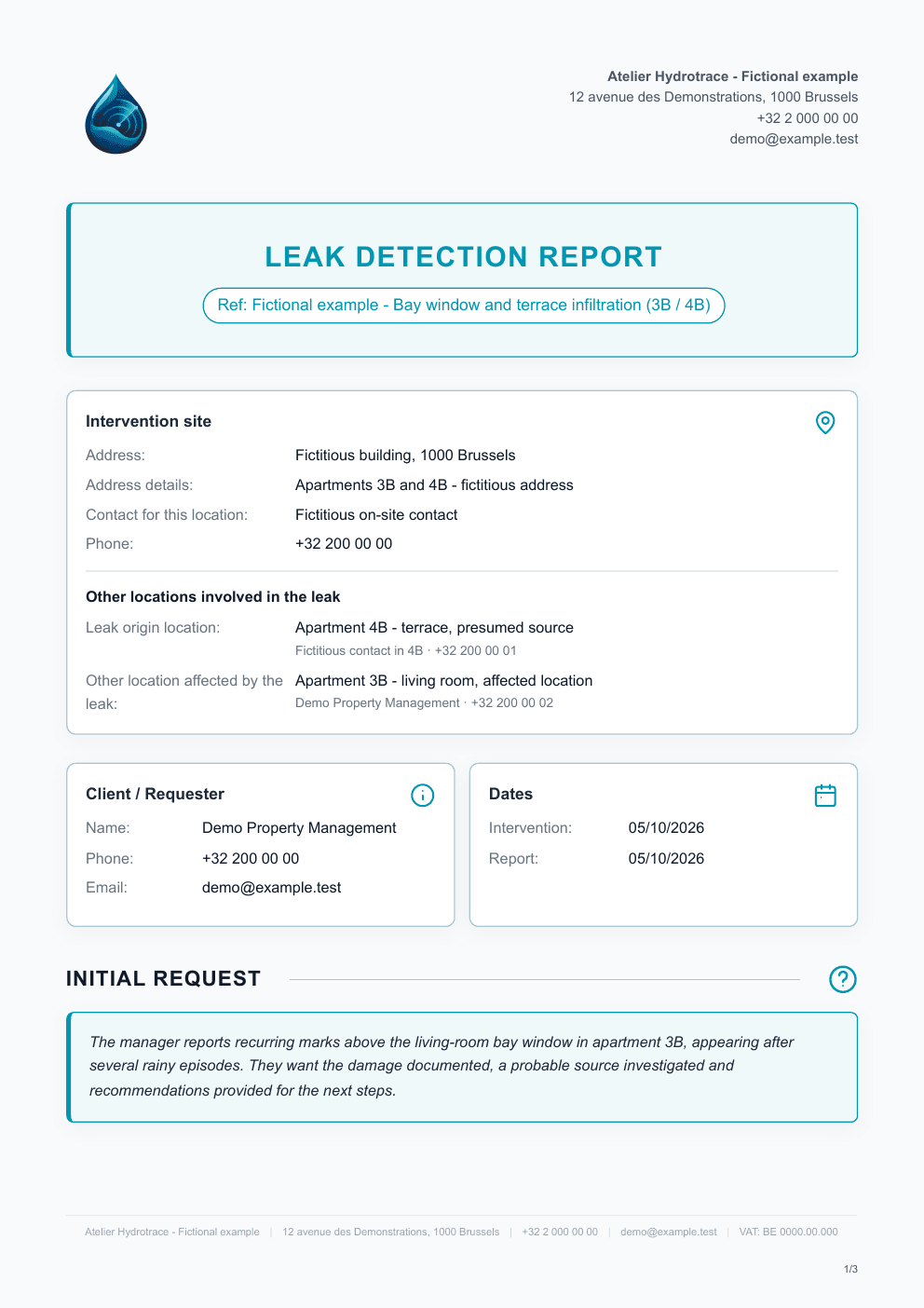
The three-page PDF example was generated with Untopo for a fictional intervention in a shared building. It presents an affected apartment, a suspected source on the terrace above, illustrated findings, methods, a conclusion, and recommendations. The company identity and logo are fictional as well.
The four report visuals are generated illustrations, not photographs from a real intervention. This is not a universal regulatory form: its purpose is to show what a structured and adaptable report can look like.
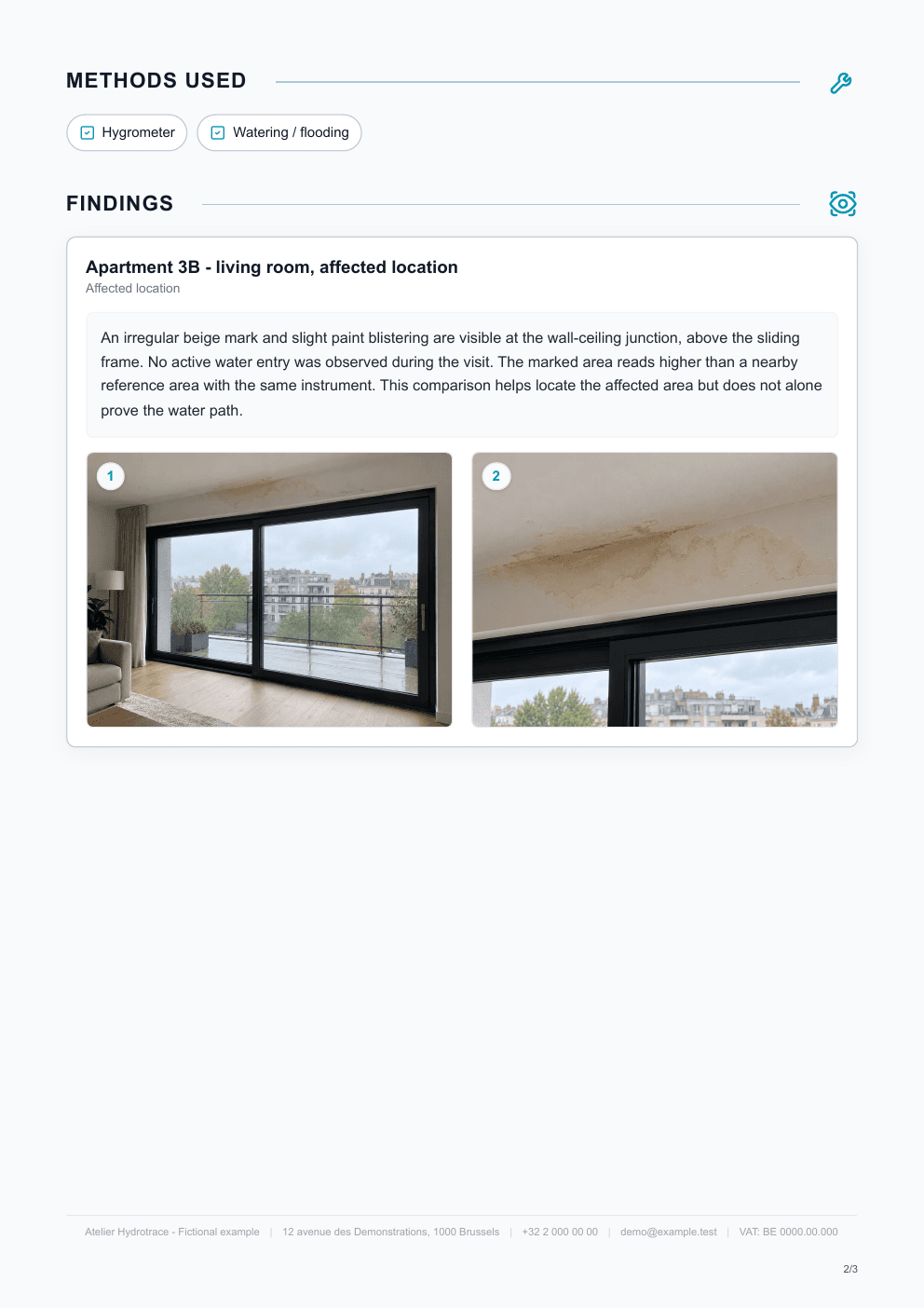
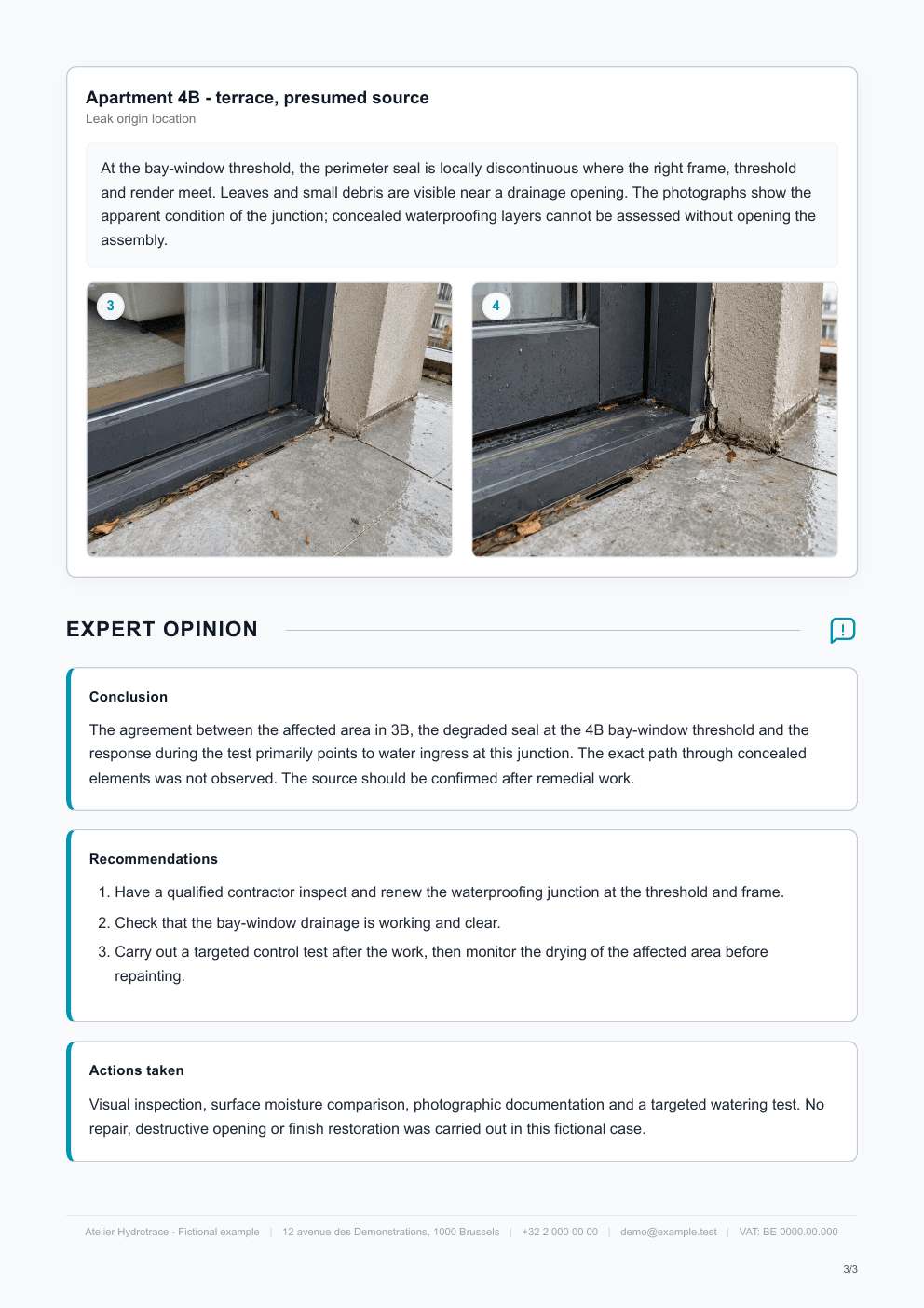
The first page introduces the request and the locations involved; the second shows the methods and the illustrated findings in apartment 3B; the third connects the terrace observation in apartment 4B to a cautious conclusion and practical next steps.
You can also download a separate blank template to prepare your own case. It distinguishes the locations involved, observed facts, methods and results, then the conclusion and recommended next steps. The blank template contains no intervention photos.
What should a leak detection report include?
1. Intervention details
Address, client or requester, intervention date, report date and, where useful, the case reference or dates of several visits.
The goal is to let the reader identify the case immediately.
2. Reason for the intervention
Describe the reported situation in a few lines before the investigation begins.
Example:
Infiltration reported on the living-room ceiling during heavy rainfall.
This describes the initial request without announcing a source that has not yet been demonstrated.
3. Source and affected locations
In a building, the place where damage appears is not always the place where the source is located.
When useful, clearly distinguish:
- the suspected or identified source location;
- the affected location or locations;
- the contact associated with each location.
This distinction is especially useful in shared buildings.
4. Findings and photos
Describe what was actually observed: marks, damage, measurements, visible defects, test results, or the absence of an expected anomaly.
Place photos next to the relevant finding rather than creating a gallery that is difficult to interpret at the end of the report.
5. Methods used
List the techniques actually used: visual inspection, moisture meter, thermal camera, pressure test, tracer gas, endoscopy, dye, water test, acoustic detection, and so on.
The method is most useful when it is linked to its result.
6. Conclusion
The conclusion answers the central question: which source is identified or considered probable based on the observed evidence?
The level of certainty should match the case. A source may be identified, probable, compatible with the findings, or unconfirmed at this stage.
7. Recommendations
Describe the next steps: repair, additional testing, specialist intervention, a new test after the work, or monitoring.
8. Completed actions
Keep separate what was already done during the intervention and what is still recommended afterwards.
Example: from finding to conclusion
Fictional reason for the visit
Recurring marks above the living-room bay window in apartment 3B after heavy rain.
Simulated finding in the affected apartment
Halo above the frame and slight paint blistering. No active water ingress at the time of the fictional visit.
Simulated finding in the upper apartment
Locally discontinuous seal at the junction between the window frame and threshold in apartment 4B. Leaves and small debris near a drainage opening.
Simulated method
Visual inspection, surface moisture comparison, and a water test limited to the affected junction. None of these tests was actually carried out for this example.
Scenario conclusion
The alignment between the marks in apartment 3B, the apparent defect at the junction in apartment 4B, and the described response during the water test points towards water entering at that location. The exact path through concealed elements was not observed.
Recommendation
Have the junction checked and resealed, verify drainage, then carry out a control test after the work before restoring finishes in apartment 3B.
A PDF template or specialised software?
A Word or PDF template may be enough when report volume is low. As interventions increase, the lost time often comes less from writing itself than from everything around it: transferring photos, finding contact details, rebuilding the layout, duplicating an old file, and generating the PDF.
Untopo keeps a clear structure while letting you create the report directly on mobile or desktop.
Short FAQ
Is there a mandatory format for a leak detection report?
There is no single template that applies to every situation, insurer, and country. Expected content depends on the case and the recipient. A clear report should make the context, findings, investigations, conclusion, and recommended next steps easy to understand.
Can this template be used for an insurance case?
Yes, as a working basis. The information requested may vary by insurer, policy, contract, country, or claim. The template should therefore remain adaptable.
Can several apartments be included in one report?
Yes. In a shared building, it can be useful to distinguish several source locations and affected locations, with their respective contacts.
Does Untopo replace my billing or planning software?
Not necessarily. Untopo can be used only for reports and fit into your existing organisation. Other features may be added over time without requiring a full migration.